Biomanufacturing, characterisation, and sustainability assessment of fungal-based building materials
Imagine a new material for our built environment.
A material that provides a sustainable alternative to the dominant energy consuming materials.
A material that offers a fresh perspective on the challenges facing today’s building industry.
Picture a material that is renewable and that creates carbon sinks as we build homes, schools, universities, and even factories of the future.
News

-
Open Call: Artist-in-Residence programme SPORELATION @ MY-CO BUILD | Applications due by September 10, 2026
-
We contribute to the exhibition ‘Tiny Giants: The Power of Microorganisms’ 5 September 2026 – 17 May 2027 @Mühlerama, Zurich
-
We contribute to the exhibition ‚SuperCity 3000. Our City of the Future‘ at Deutsches Technikmuseum
Publications
-
How to get the most out of fungal biotechnology?
-
Impact of Fomes fomentarius growth on the mechanical properties of material extrusion additively manufactured PLA and PLA/Hemp biopolymers.
-
Structural, mechanical, and genetic insights into heat-pressed fomes fomentarius mycelium from solid-state and liquid cultivations.
Mission & Vision
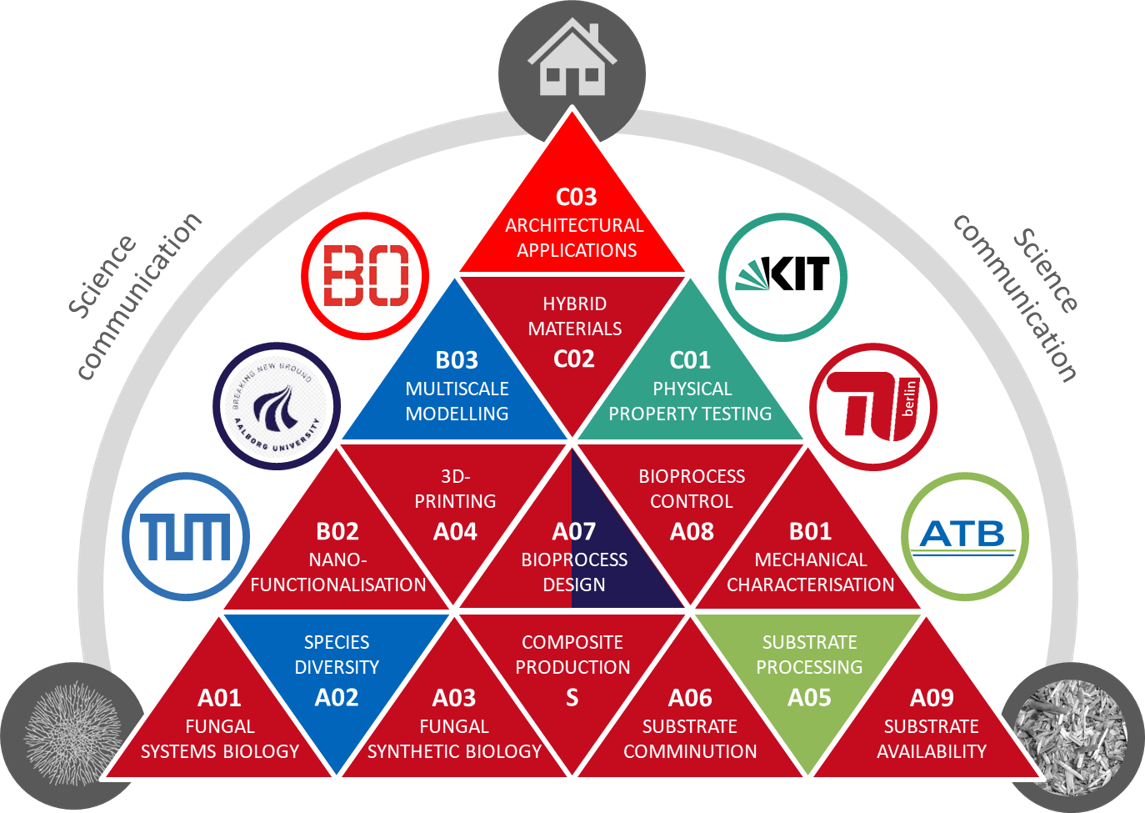
The Collaborative Research Centre (CRC) ‘MY-CO BUILD: Biomanufacturing, characterisation, and sustainability assessment of fungal-based building materials’ will develop a new class of biologically produced and biodegradable fungal-based materials from renewable and residual agricultural and forestry resources through pioneering basic research. The potential of fungal biotechnology will be used to research and develop these materials to establish the scientific basis for defined production processes and reproducible properties of fungal-based materials. This includes systematically establishing a process chain that considers all biological and technological aspects of the manufacturing process from the nano- to the macroscale, thus allowing conclusions to be drawn for targeted material design.
For the first time, the CRC will bring together different disciplines in an interdisciplinary network to investigate the biological, mechanical, physical, chemical, thermal, acoustic, and architectural properties of fungal-based materials as a function of the genetic make-up of the fungal production organism used, the properties of the agricultural and forestry substrates, and the manufacturing and processing methods. To describe, understand, and predict multiscale interactions, new mathematical models accompanied by numerical simulations will be developed to enable tailoring of material properties.
In addition to this fundamental understanding of the relationships between the hierarchical structural elements and the properties of the fungal-based materials, stability, ageing, and biodegradability testing will be carried out during the development of these materials, as well as AI-based sustainability assessments. With the processes and methods developed here, the CRC aims to break new inter- and transdisciplinary ground for the development and establishment of sustainable biomaterials that are not possible yet with current approaches.
Spokesperson:
Prof. Dr.-Ing. Vera Meyer, TU Berlin
Participating institutions:
Technische Universität Berlin,
Technische Universität München,
Karlsruhe Institute of Technology,
Bochum University of Applied Sciences,
Leibniz Institute for Agricultural Engineering
Potsdam-Bornim e.V. (ATB),
Aalborg University
Funded by: DFG with €10.3 million | Project number: 548244816
Duration: 2026–2029